Solutions / Connected device communication
Connected device communication
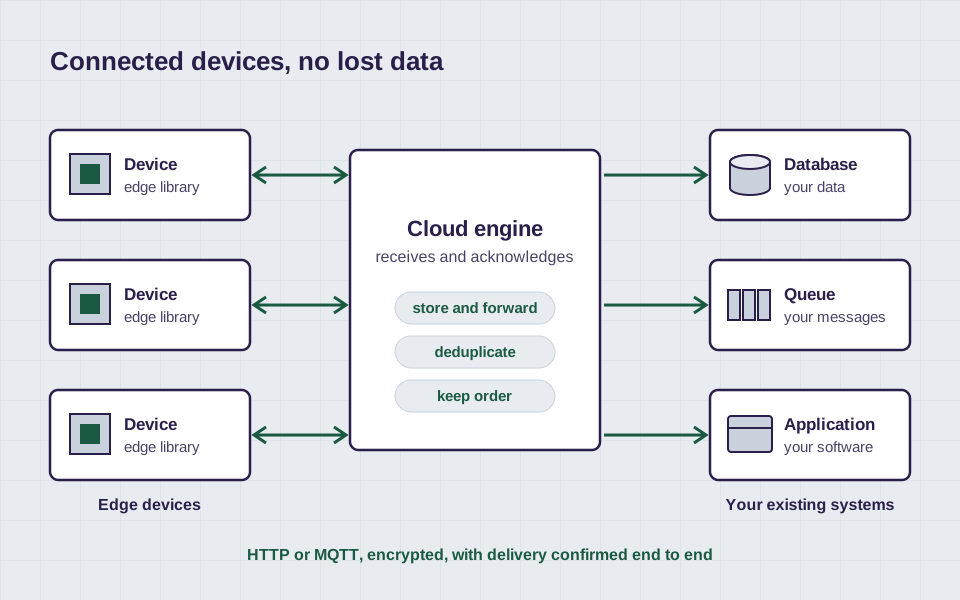
Our own edge library and cloud engine exchange data between your edge devices and your systems (server, data center, cloud or neo-cloud), reliably and without loss. Protocols such as HTTP and MQTT are chosen to fit your requirements and budget, and the solution is easy to add to what you already run.
What it is
- Edge library: runs on the device, collects data, keeps it locally until delivery is confirmed and sends it.
- Cloud engine: receives, acknowledges and orders the data and passes it on to your database, queue or application.
- Protocol choice: HTTP, MQTT or another protocol, selected for your network and budget.
Where it fits
- Standalone machines and legacy equipment that should be connected securely at minimal cost.
- Devices on unreliable or metered links, such as mobile networks.
- Organizations that already run servers, a data center or a cloud and want devices to feed them.
How data is kept lossless
Lossless delivery is the result of a few well-understood mechanisms working together.
-
1
Store and forward
The device keeps each message locally until the cloud confirms receipt.
-
2
Acknowledge and retransmit
A message without confirmation is sent again, in its original order.
-
3
Deduplicate
Every message carries a unique ID, so a retransmission never creates a duplicate record.
-
4
Encrypt and authenticate
Connections use TLS and each device proves its identity before data is accepted.
-
5
Forward to your systems
The cloud engine passes data to the systems you already run.
Delivery under a failing network
A device sends readings to the cloud engine. Switch the network off, send more readings, and switch it on again. Enable acknowledgement loss to see retransmission and duplicate removal.
Device: waiting for confirmation
Cloud engine: stored in order
Illustrative simulation of the delivery mechanism, not a measurement.
Choosing a protocol
The choice depends on message rate, link quality and the network between device and cloud.
| HTTP | MQTT | |
|---|---|---|
| Pattern | Request and response | Publish and subscribe through a broker |
| Delivery guarantees | None built in; the application implements them | Three quality-of-service levels: at most once, at least once, exactly once |
| Connection | A request per exchange, or a kept-alive connection | Long-lived connection with persistent sessions and a last-will message |
| Message overhead | Text headers on every request | Fixed header of two bytes or more |
| Best fit | Occasional or bulk uploads, firewalls and proxies, existing web APIs | Frequent small messages, unstable links, commands sent to devices |
Get it your way
NDA available on request.
License it
- Closed source, licensed for your use: device-specific license key or online authentication
- An evaluation version first, so you can test it in your own environment
- License terms agreed to fit your requirements and budget
Have it built
- Designed around your system and your problem
- Built from scratch, or adapted from an existing solution
- Source code and IP stay with you, with documentation and a handover