Solutions / Local LLM infrastructure setup
Local LLM infrastructure setup
We size, set up and bring up language-model infrastructure inside your network and connect it to your documents and tools. The model runs on your own machines, so your documents are processed under your own control.
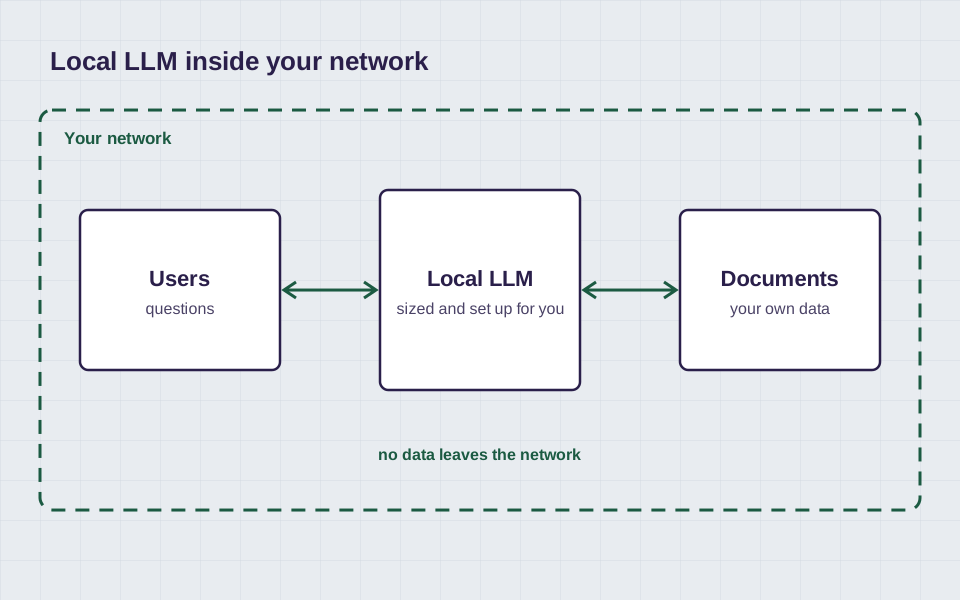
What it is
- Sizing: choosing model and hardware for your users, document volume and response-time needs.
- Serving: a model server with access control inside your network.
- Retrieval over your documents: relevant passages are found at question time and given to the model, so answers can point to their sources.
- Integration with the tools your team already uses.
Where it fits
- Organizations whose documents must stay inside their own network.
- Teams that want to search and question internal manuals, reports and tickets.
- Companies that want predictable costs instead of per-request pricing.
How a project runs
Memory is the main constraint in local LLM sizing, so the work starts with the numbers.
-
1
Define the workload
Users, concurrency, document types and the response quality you need.
-
2
Size the hardware
Memory for the model weights and for the attention cache of every active conversation.
-
3
Set up and bring up
Serving, storage, access control and the retrieval pipeline inside your network.
-
4
Evaluate on your documents
Check answer quality on real questions before release.
-
5
Hand over
Operations documentation and training for your team.
Memory sizing calculator
A first estimate of GPU memory for a model, its numeric precision, the context length and the number of simultaneous users. The calculation: weights = parameters x bytes per parameter; attention cache = 2 x layers x key-value heads x head size x context x bytes x users.
Estimate for model families with grouped-query attention. Final sizing is confirmed by benchmarking on your hardware and documents.
Get it your way
NDA available on request.
License it
- Closed source, licensed for your use: device-specific license key or online authentication
- An evaluation version first, so you can test it in your own environment
- License terms agreed to fit your requirements and budget
Have it built
- Designed around your system and your problem
- Built from scratch, or adapted from an existing solution
- Source code and IP stay with you, with documentation and a handover