Solutions / Custom computer vision training
Custom computer vision training on your data
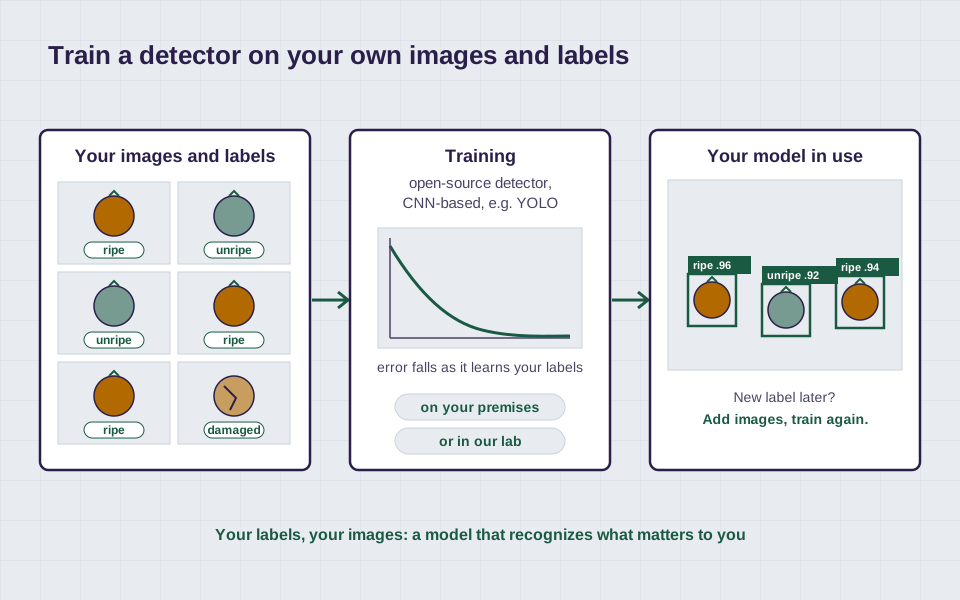
We train object detection models on your own images, with labels you define, so the model recognizes what matters in your operation. We start from open-source vision models, CNN-based detectors such as YOLO, and train them on your dataset. Training runs on your premises or in our lab.
What it is
- Your labels: you decide what the model should find, such as "ripe", "unripe" and "damaged", instead of a fixed list of everyday objects.
- Open-source starting point: an established CNN-based detector, adapted to your cameras, products and lighting by training on your images.
- Room to grow: when a new product variant or a new condition appears, add images with the new label and train again.
Where it fits
- You capture images already, but nobody has the time to look at all of them.
- General-purpose models do not know your products, parts or surroundings.
- Your images should stay on your premises, or with us under an agreed NDA.
Examples
Each one starts the same way: a few labels, a set of images from your own cameras, and a clear idea of what the model should report.
Harvest at the right time
Label fruit as unripe, turning or ripe, and damaged. The model marks what is ready to pick and where, so crews check the right rows first.
Find panels that need attention
Train on drone or camera images with labels such as cracked cell, soiling and shading. Maintenance visits go to the panels that need them.
Check loads before they leave
Detect pallets, labels and wrapping, and report loads with a missing label or damaged wrapping. New packaging types are added as new labels.
How a project runs
The measure of success is defined first and tested on images the model has not seen during training.
-
1
Define the labels and the goal
What the model should detect, how the labels are defined, and what a wrong or missed detection costs you.
-
2
Collect and label images
Images from your own cameras across the conditions that occur. We agree labeling rules with you so the labels are consistent. A few hundred labeled images per label is a workable start; the evaluation shows whether more are needed.
-
3
Train and tune
We choose an open-source detector with you, check that its license fits your use, and train it on your labeled images.
-
4
Test on unseen images
Precision and recall for each label and each condition, with the failure cases shown, so you can judge the result yourself.
-
5
Hand over and extend
You receive the trained model and the evaluation report. Delivery terms are agreed per project. New labels or new image sets mean another training round.
Where the training runs
Your images are used only for your project. NDA available on request.
On your premises
Training runs on hardware at your site or on your network, so the images do not leave your premises.
In our lab
We train on our own hardware with a copy of your images. The copy is deleted at the end of the project, as agreed with you.